
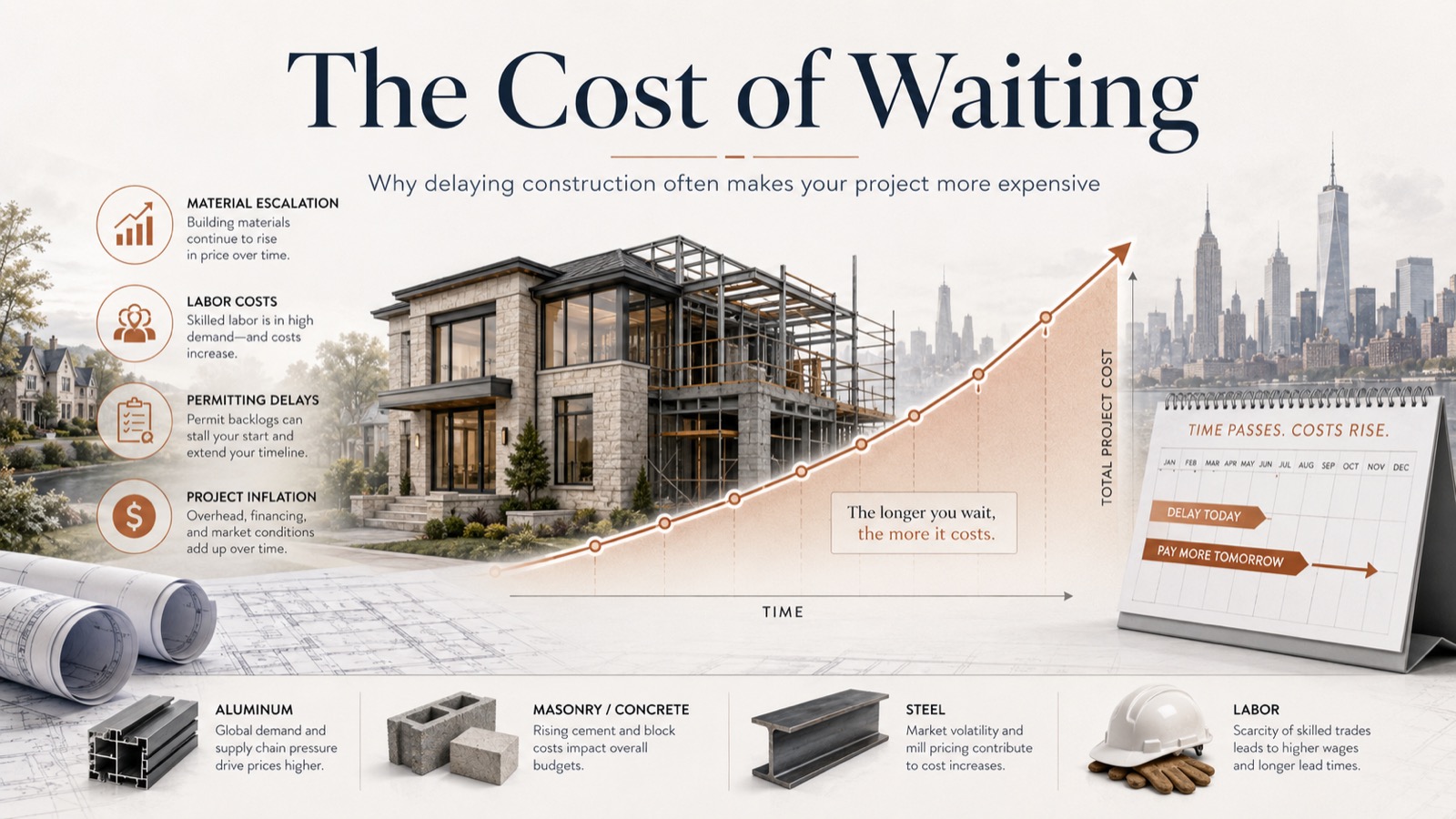
Homeowners often delay construction because they expect prices to improve.
They wait until next year. They wait for interest rates to move or material prices to come down. But in Westchester County and New York City, the total cost of construction is influenced by far more than lumber or steel. Labor, insurance, transportation, subcontractor pricing, permitting, and material escalation can all continue moving while a project sits.
Waiting isn't a neutral decision. It's a financial one, and it can prove to be an expensive strategy.
Construction Costs Are Still Rising
Rider Levett Bucknall reported an approximate 4.46% year-over-year increase in New York construction costs in Q2 2026. The Bureau of Labor Statistics also reported that national final-demand construction prices were 5.2% higher in July 2026 than in July 2025.
What does that look like in real money? For a $500,000 project, 4.5% escalation represents roughly $22,500 in additional cost over one year. For a $1 million project, it is roughly $45,000.
That added cost does not deliver a larger home, better finishes, or additional scope. It often means paying more for substantially the same project at a later date.
Some Materials Have Increased Much Faster
Certain construction inputs have risen far more aggressively than the overall market.
In July 2026, the Producer Price Index for aluminum mill shapes was 40.5% higher than a year earlier. In June 2026, copper and brass mill shapes were up approximately 26% year over year, while steel mill products were up approximately 16.9%.
Those increases affect products homeowners actually purchase: windows, doors, flashing, gutters, roofing components, HVAC equipment, electrical materials, railings, and exterior systems.
You may not purchase raw aluminum or copper directly, but the manufacturers, suppliers, and subcontractors working on your project do. Ultimately, those increases find their way into the construction budget.
Labor Is Just as Important in Westchester and NYC
Material prices tend to get the most attention, but skilled labor remains one of the most significant long-term cost pressures.
Experienced carpenters, masons, plumbers, electricians, roofers, and finish trades are limited, and sought-after crews are often booked well in advance. Their pricing is driven by wages, insurance, workers' compensation, fuel, overhead, and demand.
That matters particularly in Westchester, where renovations frequently involve older structures, custom detailing, structural modifications, waterproofing, and higher-end finishes.
New York City adds another layer of complexity: delivery restrictions, insurance requirements, building regulations, site logistics, and scheduling constraints that can easily be underestimated.
The skilled labor required to execute these projects rarely becomes less expensive with time.
Waiting Does Not Lock In Today's Price
A construction estimate reflects the market at the time it is prepared: current subcontractor bids, labor rates, material costs, supplier pricing, and availability.
If a project is postponed for twelve or eighteen months, that estimate will need to be updated. The homeowner is no longer purchasing construction at the original market price, but at a new one.
What Two Years Can Do to a $1 Million Project
Consider a $1 million renovation.
If construction costs rise by approximately 4.5% annually, the same project could cost roughly $1.09 million after two years.
That is approximately $90,000 in added cost, without another room, an upgraded kitchen, or a single additional square foot.
That is the financial risk of waiting.
This Does Not Mean You Should Rush
Starting construction before a project is ready can be just as costly as unnecessary delay.
Few homeowners know every detail they want from the outset, but there is a practical middle ground. Developing as clear a vision as possible before construction begins is one of the best ways to reduce surprise costs.
Complete the drawings. Resolve major design decisions. Select key materials. Build in contingency. Make sure the contractor understands the full scope.
But once a project is properly designed, priced, and ready to move forward, delaying solely in the hope that construction will become cheaper is a bet against the trend.
A better approach: plan carefully, price the work intelligently, identify long-lead materials early, and move decisively once the project is ready.
Time Is a Line Item, Even When You Can't See It
Construction budgets show lumber, concrete, roofing, electrical, plumbing, and labor. They do not include a line item called "waiting," but waiting still carries a cost.
Think of it as opportunity cost. As the saying goes, more is lost to indecision than to the wrong decision.
For homeowners considering a renovation, addition, or new home in Westchester County or New York City, the question should not only be:
"Could construction get cheaper if we wait?"
It should also be:
"What will this project cost us if it gets more expensive?"
At Prufrock Builders, our approach is simple: plan thoroughly, price realistically, and move decisively when the project is ready.